English
 German
 Arabic
 Thai
 Vietnamese
 Spanish
 French
 Chinese
 Japanese

Heat stress and mycotoxin exposure can place simultaneous pressure on broiler health and metabolism. Understanding how nutritional interventions respond to this dual challenge is an important area of poultry research.
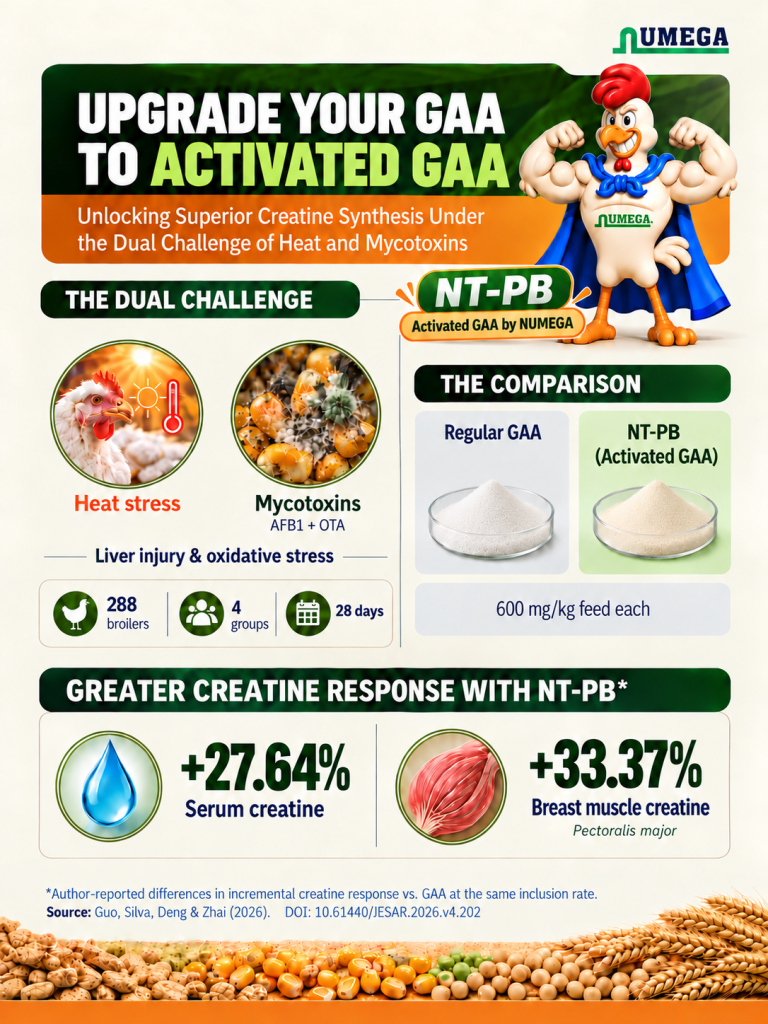
A study published in 2026 examined the creatine-related responses of broilers supplemented with regular guanidinoacetic acid (GAA) or activated GAA, supplied under NUMEGA’s trade name NT-PB.
A Comparison at the Same Inclusion Rate
The 28-day study involved 288 broilers, with both GAA forms supplemented at 600 mg/kg feed.
Under combined hot environmental conditions and mycotoxin exposure, both forms significantly increased serum and breast muscle creatine compared with the unsupplemented mycotoxin-challenged group.
The authors reported that the creatine increases associated with NT-PB were:
- 27.64% greater in serum than those associated with regular GAA.
- 33.37% greater in breast muscle than those associated with regular GAA.
These percentages describe author-reported differences in incremental creatine response, rather than differences in absolute creatine concentrations.
The findings highlight the value of examining the measured creatine response when comparing different GAA forms at the same inclusion rate.
Explore the Full Study
For a closer look at the experimental design, challenge conditions, complete results and the authors’ interpretation, download the full research paper using the link below.
📄 Download the full research paper (PDF):
https://acesse.one/x08sowo
NT-PB — Activated GAA by NUMEGA.
For further information about NT-PB, contact the NUMEGA team.
Research reference: Guo, Y., Silva, M., Deng, L., & Zhai, Y. (2026). Comparative Effects of Regular and Activated Guanidinoacetic Acid on Creatine Metabolism in Broilers Under Heat Stress and Mycotoxin Exposure. Journal of Environmental Science and Agricultural Research, 4(5), 1–5. DOI: 10.61440/JESAR.2026.v4.202.
 Comment